History of The Monkees
From Wikipedia, the free encyclopedia
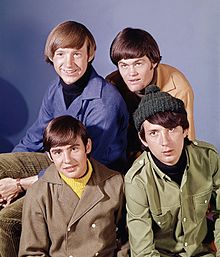
The Monkees were an American rock and pop band originally active between 1966 and 1971, with reunion albums and tours in the decades that followed. They were formed in Los Angeles in 1965 by Bob Rafelson and Bert Schneider for the American television series The Monkees which aired from 1966 to 1968. The musical acting quartet was composed of Americans Micky Dolenz, Michael Nesmith, and Peter Tork; and British actor and singer Davy Jones. The band's music was initially supervised by producer Don Kirshner, backed by the songwriting duo of Tommy Boyce and Bobby Hart.
The four actor-musicians were allowed only limited roles in the recording studio for the first few months of their five-year career as "the Monkees". This was due in part to the amount of time required to film the television series. Nonetheless, Nesmith did compose and produce some songs from the beginning, and Peter Tork contributed limited guitar work on the sessions produced by Nesmith. They eventually fought for the right to collectively supervise all musical output under the band's name. The television show was canceled in 1968, but the band continued to record music through 1971.
A revival of interest in the television show came in 1986, which led to a series of reunion tours and new records. The group has reunited and toured several times since then with different line-ups and varying degrees of success.
After Davy Jones died on February 29, 2012, the surviving members reunited for a tour in November–December 2012 and again in 2013 for a 24-date tour. The Monkees continued to tour through their 2016 50th Anniverary, with Dolenz and Tork forming the core of the band and Nesmith continuing to join them occasionally.
Dolenz described the Monkees as initially being "a TV show about an imaginary band… that wanted to be the Beatles that was never successful". Ironically, the actor-musicians became one of the most successful bands of the 1960s. The Monkees have sold more than 75 million records worldwide making them one of the biggest selling groups of all time with international hits, including "Last Train to Clarksville", "Pleasant Valley Sunday", "Daydream Believer", and "I'm a Believer". Newspapers and magazines reported that the Monkees outsold the Beatles and the Rolling Stones combined in 1967, but Nesmith claims in his autobiography Infinite Tuesday that it was a lie that he told an Australian reporter.
Conception
Aspiring filmmaker Bob Rafelson developed the initial idea for The Monkees in 1962, but was unsuccessful in selling the series. He had tried selling it to Revue, the television division of Universal Pictures.[15] In May 1964, while working at Screen Gems, Rafelson teamed up with Bert Schneider, whose father, Abraham Schneider, headed the Colpix Records and Screen Gems Television units of Columbia Pictures. Rafelson and Schneider ultimately formed Raybert Productions.[16]
The Beatles' film A Hard Day's Night inspired Rafelson and Schneider to revive Rafelson's idea for The Monkees. As "The Raybert Producers", they sold the show to Screen Gems Television on April 16, 1965. Rafelson and Schneider's original idea was to cast an existing New York folk rock group, the Lovin' Spoonful, who were not widely known at the time. However, John Sebastian had already signed the band to a record contract, which would have denied Screen Gems the right to market music from the show.
On July 14, 1965, The Hollywood Reporter stated that future band member Davy Jones was expected to return to the United States in September 1965 after a trip to England "to prepare for TV pilot for Bert Schneider and Bob Rafelson". Jones had previously starred as the Artful Dodger in the Broadway theatre show Oliver!, which debuted on December 17, 1962, and his performance was later seen on The Ed Sullivan Show the same night as the Beatles' first appearance on that show, February 9, 1964. He was nominated for a Tony Award for Best Featured Actor in a Musical in 1963. In September 1964 he was signed to a long-term contract to appear in TV programs for Screen Gems, make feature films for Columbia Pictures and to record music for the Colpix label. Rafelson and Schneider already had him in mind for their project after their plans for the Lovin' Spoonful fell through; when they chose him, he was essentially a proto-star looking for his lucky break.
On September 8–10, 1965, Daily Variety and The Hollywood Reporter ran an ad to cast the remainder of the band/cast members for the TV show:
Madness!! Auditions. Folk & Roll Musicians-Singers for acting roles in new TV series. Running Parts for 4 insane boys, age 17-21. Want spirited Ben Frank's types. Have courage to work. Must come down for interview.
Out of 437 applicants, the other three chosen for the cast of the TV show were Michael Nesmith, Peter Tork and Micky Dolenz. Nesmith had been working as a musician since early 1963 and had been recording and releasing music under various names, including Michael Blessing and "Mike & John & Bill" and had studied drama in college. Of the final four, Nesmith was the only one who actually saw the ad in Daily Variety and The Hollywood Reporter. Tork, the last to be chosen, had been working the Greenwich Village scene as a musician, and had shared the stage with Pete Seeger; he learned of The Monkees from Stephen Stills, whom Rafelson and Schneider had rejected as a songwriter. Dolenz was an actor (his father was veteran character actor George Dolenz) who had starred in the TV series Circus Boy as a child, using the stage name Mickey Braddock, and he had also played guitar and sung in a band called the Missing Links before the Monkees, which had recorded and released a very minor single, "Don't Do It". By that time he was using his real name; he found out about The Monkees through his agent.
Developing the music for their debut album

During the casting process Don Kirshner, Screen Gems' head of music, was contacted to secure music for the pilot that would become The Monkees. Not getting much interest from his usual stable of Brill Building writers, Kirshner assigned Tommy Boyce and Bobby Hart to the project. The duo contributed four demo recordings for the pilot. One of these recordings was "(Theme From) The Monkees" which helped get the series the green light.
When The Monkees was picked up as a series, development of the musical side of the project accelerated. Columbia-Screen Gems and RCA Victor entered into a joint venture called Colgems Records primarily to distribute Monkees records. Raybert set up a rehearsal space and rented instruments for the group to practice playing in April 1966, but it quickly became apparent they would not be in shape in time for the series debut. The producers called upon Kirshner to recruit a producer for the Monkees sessions.
Kirshner called on Snuff Garrett, composer of several hits by Gary Lewis & the Playboys, to produce the initial musical cuts for the show. Garrett, upon meeting the four Monkees in June 1966, decided that Jones would sing lead, a choice that was unpopular with the group. This cool reception led Kirshner to drop Garrett and buy out his contract. Kirshner next allowed Nesmith to produce sessions, provided he did not play on any tracks he produced. Nesmith did, however, start using the other Monkees on his sessions, particularly Tork as a guitarist. Kirshner came back to the enthusiastic Boyce and Hart to be the regular producers, but he brought in one of his top East Coast associates, Jack Keller, to lend some production experience to the sessions. Boyce and Hart observed quickly that when brought into the studio together, the four actors would fool around and try to crack each other up. Because of this, they would often bring in each singer individually.
According to Nesmith, it was Dolenz's voice that made the Monkees' sound distinctive, and even during tension-filled times Nesmith and Tork sometimes turned over lead vocal duties to Dolenz on their own compositions, such as Tork's "For Pete's Sake", which became the closing title theme for the second season of the television show.
The Monkees' debut and second albums were meant to be a soundtrack to the first season of the TV show, to cash in on the audience. In the 2006 Rhino Deluxe Edition re-issue of their second album, More of the Monkees, Mike Nesmith stated, "The first album shows up and I look at it with horror because it makes us appear as if we are a rock 'n' roll band. There's no credit for the other musicians. I go completely ballistic, and I say, 'What are you people thinking?' The powers that be say, 'Well, you know, it's the fantasy.' I say, 'It's not the fantasy. You've crossed the line here! You are now duping the public. They know when they look at the television series that we're not a rock 'n' roll band; it's a show about a rock 'n' roll band. ... nobody for a minute believes that we are somehow this accomplished rock 'n' roll band that got their own television show. ... you putting the record out like this is just beyond the pale." Within a few months of their debut album, Music Supervisor Don Kirshner would be forcibly dismissed and the Monkees would take control as a real band.
The Monkees' first single, "Last Train to Clarksville" b/w "Take a Giant Step", was released in August 1966, just weeks prior to the TV broadcast debut. In conjunction with the first broadcast of the television show on September 12, 1966, on the NBC television network, NBC and Columbia had a major hit on their hands. The first long-playing album, The Monkees, was released a month later, spent 13 weeks at #1 and stayed on the Billboard charts for 78 weeks. Twenty years later, during their reunion, it would spend another 24 weeks on the Billboard charts. This first album is also notable, in addition to containing their debut single, for containing band member Nesmith's first foray into country-rock, "Papa Gene's Blues", which mixed country, rock and Latin flavors.
From television to concert stage
In assigning instruments for purposes of the television show, a dilemma arose as to which of the four would be the drummer. Both Nesmith (a skilled guitarist and bassist) and Tork (who could play several stringed and keyboard instruments) were peripherally familiar with the instrument but both declined to give the drum set a try. Jones knew how to play the drums and tested well enough initially on the instrument, but the producers felt that, behind a drum kit, the camera would exaggerate his short stature and make him virtually hidden from view. Thus, Dolenz (who only knew how to play the guitar) was assigned to become the drummer. Tork taught Dolenz his first few beats on the drums, enough for him to fake his way through filming the pilot, but he was soon taught how to play properly. Thus, the lineup for the TV show most frequently featured Nesmith on guitar, Tork on bass, Dolenz on drums and Jones as a frontman, singer and percussionist. This, however, is in opposition to the lineup which would have made the most sense based upon the members' musical strengths. For example, Tork was actually a more experienced guitar player than Nesmith, while Nesmith had at one time specifically trained on the bass. While Jones certainly had a strong lead voice and sings lead on several Monkees recordings, Dolenz's voice is regarded, particularly by Nesmith, as one of the most distinctive in popular music history and a hallmark of the Monkees' sound. This theoretical lineup was actually depicted once, in the music video for the band's song "Words", which shows Jones on drums, Tork playing lead guitar, Nesmith on bass and Dolenz fronting the group. In concert appearances Tork also took much of the guitar duties, even in appearances with Nesmith, and Dolenz often plays rhythm guitar on stage.
Unlike most television shows of the time, The Monkees episodes were written with many setups, requiring frequent breaks to prepare the set and cameras for short bursts of filming. Some of the "bursts" are considered proto-music videos, inasmuch as they were produced to sell the records. The Monkees Tale author Eric Lefcowitz noted that the Monkees were—first and foremost—a video group. The four actors would spend 12-hour days on the set, many of them waiting for the production crew to do their jobs. Noticing that their instruments were left on the set unplugged, the four decided to turn them on and start playing.
After working on the set all day, the Monkees (usually Dolenz or Jones) would be called into the recording studio to cut vocal tracks. As the band was essential to this aspect of the recording process, there were few limits on how long they could spend in the recording studio, and the result was an extensive catalogue of unreleased recordings.
Independence
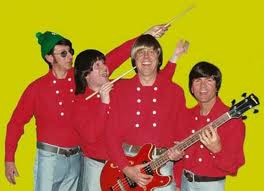
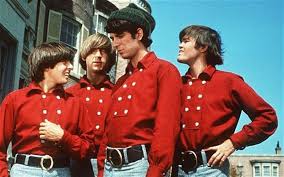
The Monkees wanted to pick the songs they sang and play on the songs they recorded, and be the Monkees. With Kirshner dismissed as musical supervisor, in late February 1967 Nesmith hired former Turtles bassist Douglas Farthing Hatlelid, who was better known by his stage name Chip Douglas, to produce the next Monkees album, which was to be the first Monkees album where they were the only musicians, outside of most of the bass, and the horns. Douglas was responsible for both music presentation—actually leading the band and engineering recordings—and playing bass on most of Headquarters. This album, along with their next, Pisces, Aquarius, Capricorn & Jones Ltd., would serve as the soundtrack to the second season of the television show.
In March 1967 "The Girl I Knew Somewhere", composed by Nesmith and performed by Dolenz, Nesmith, Tork and bassist John London, was issued as the B-side to the Monkees' third single, "A Little Bit Me, a Little Bit You", and it rose to No. 39 on the charts. The A-side rose to No. 2.
Issued in May 1967, Headquarters had no songs released as singles in the United States, but it would still be their third No. 1 album in a row, with many of its songs played on the second season of the television show. Having a more country-folk-rock sound than the pop outings under Kirshner, Sandoval notes in the 2007 Deluxe Edition reissue from Rhino that the album rose to No. 1 on May 24, 1967, with the Beatles' Sgt. Pepper released the following week, which would knock Headquarters to the #2 spot on the charts for the next 11 weeks, the same weeks which would become known by the counterculture as the "Summer of Love". A selection that Dolenz wrote and composed, "Randy Scouse Git", was issued under the title "Alternate Title" (owing to the controversial nature of its original title) as a single internationally, where it rose to No. 2 on the charts in the UK and Norway, and in the top 10 in other parts of the world. Tork's "For Pete's Sake" would be used as the closing theme for the television show. Nesmith would continue in his country-rock leanings, adding the pedal steel guitar to three of the songs, along with contributing his self-composed countrified-rock song "Sunny Girlfriend". Tork added the banjo to the Nesmith-composed rocker "You Told Me", a song whose introduction was satirical of the Beatles' "Taxman". Other notable songs are the Nesmith-composed straightforward pop-rock song "You Just May Be the One", used on the television series during both seasons, along with "Shades of Gray" (with piano introduction written by Tork), "Forget that Girl", and "No Time", used in the television show. The Monkees wrote five of the 12 songs on the album, plus the two tracks "Band 6" and "Zilch". The Los Angeles Times, when reviewing Headquarters, stated that "The Monkees Upgrade Album Quality" and that "The Monkees are getting better. Headquarters has more interesting songs and a better quality level [than previous albums] . . . None of the tracks is a throwaway . . . The improvement trend is laudable."
The high of Headquarters was short-lived, however. Recording and producing as a group was Tork's major interest and he hoped that the four would continue working together as a band on future recordings, according to the liner notes of the 2007 Rhino reissue of Pisces, Aquarius, Capricorn & Jones Ltd.. "Cuddly Toy" on Pisces, Aquarius, Capricorn & Jones Ltd. would mark the last time Dolenz, who originally played guitar before the Monkees, would make a solo stand as a studio drummer. In commentary for the DVD release of the second season of the show, Tork said that Dolenz was "incapable of repeating a triumph." Having been a drummer for one album, Dolenz lost interest in being a drummer and indeed, he largely gave up playing instruments on Monkees recordings (producer Chip Douglas also had identified Dolenz's drumming as the weak point in the collective musicianship of the quartet, having to splice together multiple takes of Dolenz's "shaky" drumming for final use). By this point the four did not have a common vision regarding their musical interests, with Nesmith and Jones also moving in different directions—Nesmith following his country/folk instincts and Jones reaching for Broadway-style numbers. The next three albums featured a diverse mixture of musical style influences, including country-rock, folk-rock, psychedelic rock, soul/R&B, guitar rock, Broadway and English music hall sensibilities.
At the height of their fame in 1967, they also suffered from a media backlash. Nesmith states in the 2007 Rhino reissue of Pisces, Aquarius, Capricorn & Jones Ltd., "Everybody in the press and in the hippie movement had got us into their target window as being illegitimate and not worthy of consideration as a musical force or certainly any kind of cultural force. We were under siege; wherever we went there was such resentment for us. We were constantly mocked and humiliated by the press. We were really gettin' beat up pretty good. We all knew what was going on inside. Kirshner had been purged. We'd gone to try to make Headquarters and found out that it was only marginally okay and that our better move was to just go back to the original songwriting and song-making strategy of the first albums except with a clear indication of how the music came to be . . . The rabid element and the hatred that was engendered is almost impossible to describe. It lingers to this day among people my own age." Tork disagreed with Nesmith's assessment of Headquarters, stating, "I don't think the Pisces album was as groovy to listen to as Headquarters. Technically it was much better, but I think it suffers for that reason."
With Pisces, Aquarius, Capricorn & Jones Ltd., the Monkees' fourth album, they went back to making music for the television show, except that they had control over the music and which songs would be chosen. They used a mixture of themselves and session musicians on the album. They would use this strategy of themselves playing, plus adding session musicians (including the Wrecking Crew, Louie Shelton, Glen Campbell, members of the Byrds and the Association, drummer "Fast" Eddie Hoh, Lowell George, Stephen Stills, Buddy Miles, and Neil Young) throughout their recording career, relying more on session musicians when the group became temporarily estranged after Pisces, Aquarius, Capricorn & Jones Ltd. and recorded some of their songs separately.
Using Chip Douglas again to produce, Pisces, Aquarius, Capricorn & Jones Ltd., released in November 1967 was the Monkees' fourth No. 1 album in a row, staying at No. 1 for 5 weeks, and was also their last No. 1 album. It featured the hit single "Pleasant Valley Sunday" (#3 on charts) b/w "Words" (#11 on charts), the A-side had Nesmith on electric guitar/backing vocals, Tork on piano/backing vocals, Dolenz on lead vocals and possibly guitar and Jones on backing vocals; the B-side had Micky and Peter alternating lead vocals, Peter played organ, Mike played guitar, percussion, and provided backing vocals, and Davy provided percussion and backing vocals. Other notable items about this album is that it features an early use of the Moog synthesizer on two tracks, the Nesmith-penned "Daily Nightly", along with "Star Collector". All of its songs, except for two, were featured on the Monkees' television show during the second season.
The song "What Am I Doing Hangin' 'Round?", recorded in June 1967 and featured on Pisces, Aquarius, Capricorn & Jones Ltd., is seen as a landmark in the fusion of country and rock despite Nesmith's prior country-flavored rock songs for the Monkees. Nesmith stated, "One of the things that I really felt was honest was country-rock. I wanted to move the Monkees more into that because ... if we get closer to country music, we'll get closer to blues, and country blues, and so forth. ... It had a lot of un-country things in it: a familiar change from a I major to a VI minor — those kinds of things. So it was a little kind of a new wave country song. It didn't sound like the country songs of the time, which was Buck Owens."
Their next single, "Daydream Believer" (with a piano intro written by Tork), would shoot to No. 1 on the charts, letting the Monkees hold the No. 1 position in the singles chart and the album chart with Pisces simultaneously. "Daydream Believer" used the non-album track "Goin' Down" as its B-side, which featured Nesmith and Tork on guitar with Micky on lead vocals.
During their 1986 reunion, both Headquarters and Pisces, Aquarius, Capricorn & Jones Ltd. would return to the charts for 17 weeks.